

Complete Home Gym Setup Guide for Indian Homes (2026 Edition)
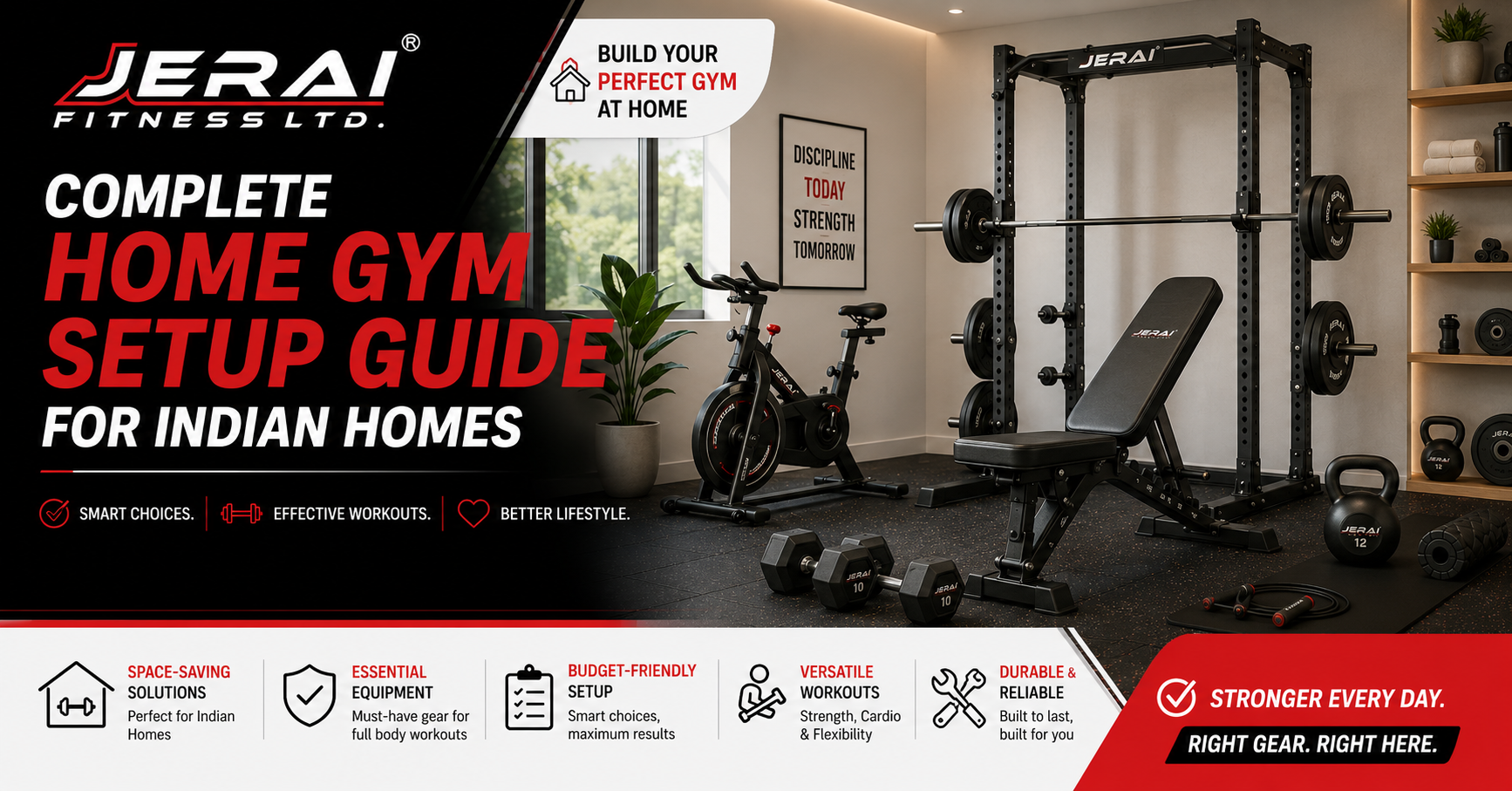
You have been thinking about it for a while. Skip the commute. Train on your own schedule. No waiting for equipment. No monthly membership renewal. A complete home gym setup makes all of this possible, and if you plan it right, it does not require a dedicated bungalow or a spare room the size of a basketball court.
This guide walks you through everything: how to plan your space, which equipment to prioritise, what to buy in what order, and how to avoid the most common mistakes Indian buyers make when setting up a home gym for the first time.
Why a Home Gym Makes Sense for Indian Households in 2025
Let us start with the numbers. A mid-tier gym membership in metro cities like Mumbai, Bengaluru, or Delhi ranges from Rs. 1,500 to Rs. 4,000 per month. Over five years, that is anywhere from Rs 90,000 to Rs 240,000, before accounting for fuel, travel time, or peak-hour parking. A well-planned home gym setup, bought once and maintained properly, usually pays for itself within two to three years.
Beyond the money, there is the consistency factor. According to the Physical Activity Guidelines issued by the Indian Council of Medical Research, adults need at least 150 minutes of moderate-intensity aerobic activity per week. People who train at home tend to hit that target more reliably because they remove the friction of travel and scheduling. The gym is always open. Rain, traffic, and odd working hours stop being reasons to skip.
Step 1: Assess Your Space Before Buying Anything
This is where most people go wrong. They buy equipment first and measure later.
Here is the right order:
-
Measure the floor area you plan to dedicate to training.
-
Measure ceiling height (especially if you plan to do overhead presses or pull-ups).
-
Check ventilation and lighting.
-
Check the floor load capacity if you live in a flat above the ground floor.
Space benchmarks for a home gym in India:
-
Under 50 sq ft: Compact setup only. Dumbbells, a mat, resistance bands, and a pull-up bar in a doorframe.
-
50 to 100 sq ft: A bench, dumbbells, a barbell set, and one cardio machine.
-
100 to 200 sq ft: Room for a multi-station machine, a treadmill or spinning bike, and a free-weights area.
-
200+ sq ft: A near-complete setup with a power rack, full cable system, cardio equipment, and dedicated flooring.
Ceiling height matters more than people expect. For a treadmill incline at maximum grade, you need at least 8 feet. For the overhead barbell press, 9 feet is more comfortable.
Step 2: Build Your Complete Home Gym Setup in Phases
You do not need to spend everything up front. A phased approach means you start training immediately and add equipment as your budget and training goals grow.
Phase 1: Foundation (Strength and Movement Basics)
Adjustable Dumbbell Set or Fixed Dumbbell Rack
Dumbbells cover the widest range of exercises for the floor space they occupy. You can train chest, back, shoulders, arms, and legs with a pair of dumbbells and nothing else. Start with a light pair and a moderate pair. Add heavier weights as your strength improves.
Rubber-coated dumbbells are the better choice for home use. They protect your floor tiles, reduce noise when set down, and last longer in humid Indian climates than bare cast iron.
Workout Bench
A flat bench works fine to start. An adjustable bench (flat to incline to decline) opens up far more exercise variations. Check the maximum weight capacity before buying. A bench that maxes out at 100 kg user weight becomes a problem quickly once you add the barbell or hold dumbbells in both hands.
Resistance Bands
An underrated inclusion. Bands warm up joints before heavy lifts, add resistance to bodyweight movements, and give you a full training session when you travel. A set with three resistance levels (light, medium, heavy) covers most uses.
Pull-Up Bar
Doorframe pull-up bars cost little and add one of the most effective upper-body pulling movements to your training. Mounted pull-up bars are sturdier and support heavier users. If you have a concrete lintel or beam available, a fixed wall-mounted bar is worth the small installation cost.
Phase 2: Free Weights and Strength Structure
Olympic Barbell and Weight Plates
Once you move past dumbbell training, a barbell lets you squat, deadlift, bench press, and row with progressively heavier loads. A standard 20 kg Olympic barbell pairs with bumper or rubber-coated plates. Bumper plates are floor-friendly and quieter, which matters in apartments.
Buy a bar with a knurling pattern that matches your grip preference. Aggressive knurling works well for deadlifts. Moderate knurling is more comfortable for high-rep sets.
Power Rack or Squat Stand
A power rack with safety bars lets you squat and bench press alone without a spotter. This is a safety requirement, not a luxury. Training heavily without safety catches is how injuries happen. A half-rack takes up less space than a full power rack and suits most home gym setups.
Phase 3: Cardio Equipment
Treadmill
Walking and running remain among the most researched and accessible forms of cardiovascular exercise. The American College of Sports Medicine recommends at least 150 minutes per week of moderate aerobic activity for healthy adults (Source: American College of Sports Medicine, ACSM's Guidelines for Exercise Testing and Prescription, 10th Edition, 2018, https://www.acsm.org).
A motorised treadmill with variable speed and incline lets you meet that target regardless of weather, air quality (a real concern in many Indian cities), or time of day. Look for a continuous horsepower rating of at least 2.0 CHP for walking and light jogging. For regular running, 2.5 CHP or above is better. Belt dimensions should be at least 50 cm wide and 140 cm long.
Jerai Fitness offers the Treadmill F24 for home use, built with a focus on consistent motor performance and a frame designed for daily residential use.
Spinning Bike
A spinning bike suits people who prefer lower-impact cardio or who have knee and hip concerns that make running uncomfortable. A weighted flywheel (18 kg or heavier) gives smooth, consistent resistance. Adjustable seat height and handlebar position mean the bike fits different body types without modification.
The Pro Spinning Bike from Jerai Fitness is built for home use, with adjustable resistance and a design that fits most room layouts without requiring large clearances on all sides.
Phase 4: Machine-Based Training
Personal Training Station or Multi-Station Home Gym
A multi-station home gym or personal training station brings cable-based movements into your home setup. Cable work trains muscles through their full range of motion with constant tension, which free weights do not replicate as well. Pull-downs, cable rows, chest flies, and tricep press-downs all become possible from one machine.
The Personal Training Station 360 and the Super Personal Training Station from Jerai Fitness are designed specifically for residential spaces. The newer New Super Personal Training Station 75 is described as a compact centrepiece that includes built-in storage for dumbbells, plates, barbells, and accessories, making it a good fit for homes where organisation matters as much as performance.
These machines suit households where more than one person trains, as different movements can happen on different cable stations simultaneously.
Step 3: Flooring, Ventilation, and Mirrors
Equipment gets most of the attention. Flooring, airflow, and lighting get neglected.
Flooring
Interlocking rubber tiles (minimum 20 mm thick) protect your floor from dropped weights, reduce vibration transferred to the slab below (important in apartment buildings), and give you safe traction under loaded movement. Lay them wall to wall in the training area, not just under machines.
Ventilation
Indian summers make training in a poorly ventilated room genuinely unpleasant. A ceiling fan plus a window fan pointed outward creates cross-ventilation. An air conditioner set between 22 and 24 degrees Celsius maintains a comfortable training temperature without the excessive energy cost of cooling a large space.
Mirrors
Wall mirrors are not a vanity. They let you check your form during squats, presses, and cable movements in real time. A single full-length mirror (minimum 5 feet tall) on one wall is enough to start.
Lighting
Warm, dim lighting is relaxing for a living room. A gym needs bright, even lighting so you can see what you are doing. Daylight white LED panels (5000K to 6500K colour temperature) work well for home gym spaces.
Step 4: Accessories That Actually Get Used
Not all accessories earn their floor space. Here are the ones that do.
-
Gym Belt: Supports the lower back during heavy deadlifts and squats. Not a substitute for good form, but a useful safety tool when loads get heavy. Jerai Fitness includes a gym belt in its accessories range.
-
Resistance Band Set: Already mentioned in Phase 1, but worth repeating. These stay useful regardless of how much other equipment you accumulate.
-
Foam Roller: Post-training recovery tool that reduces muscle soreness. Takes 10 minutes and a small corner of floor space.
-
Weight Plate Storage: A vertical plate storage tree keeps plates off the floor and reduces the chance of someone tripping over a stray 10 kg disc.
-
Dip Stand: Parallel bar dips are one of the few exercises that train the chest, triceps, and anterior shoulder simultaneously under bodyweight load. A freestanding dip stand takes up less than 2 sq ft. Jerai Fitness offers three dip stand variants at different price points.
How to Plan Your Budget for a Home Gym in India
Here is a rough framework based on commonly available equipment in the Indian market.
Starter Setup (Rs. 30,000 to Rs. 60,000): Adjustable dumbbells, flat bench, resistance bands, pull-up bar, rubber mat.
Mid-Level Setup (Rs. 60,000 to Rs. 150,000): Everything above, plus an adjustable bench, barbell and plates, squat stand, and a spinning bike.
Full Setup (Rs. 150,000 to Rs. 500,000+): Power rack, full barbell and plate set, treadmill, personal training station, rubber floor tiles, and accessories.
You do not need to reach the full setup level to train seriously. Many experienced home gym users train with setups in the mid-level range and get strong results because they are consistent and progressive in their training.
Common Mistakes to Avoid When Setting Up a Home Gym
Let's break it down by the three categories where buyers tend to lose money or motivation.
Buying too much too soon
Buying every piece of equipment at once before you build a training habit leads to underused machines and buyer's regret. Start with the basics. Add equipment when you outgrow what you have.
Skipping floor measurements
A treadmill that looks compact on a product page can still need 80 cm of clear space behind the running belt for safe use. A power rack might fit the floor area but not clear the ceiling fan. Measure twice, order once.
Ignoring warranty and after-sales support
Home gym equipment takes daily physical stress. Cables fray. Welds need inspection. Motors on treadmills require periodic maintenance. Buy from manufacturers who offer structured warranty terms and have service technicians available. Jerai Fitness, for instance, maintains a field service team of over 52 technicians across India and provides after-sales support as part of its customer service structure.
FAQs About Home Gym Setup in India
Q1. What is the minimum space needed for a complete home gym setup in an Indian flat?
A 10 by 10 foot area (roughly 9.3 sq metres) with an 8-foot ceiling height works for a functional setup that includes dumbbells, a bench, a barbell rack, and either a treadmill or a spinning bike. Tighter spaces require more planning around foldable or compact equipment options.
Q2. Is it worth buying a treadmill for home use in India, or is a spinning bike enough?
Both are worth having if your space and budget allow. A treadmill replicates walking and running patterns and suits people who want to maintain or build cardiovascular fitness through natural movement. A spinning bike is lower-impact and suits people with joint sensitivities. If you can only choose one, base it on which form of cardio you will actually do consistently.
Q3. How do I prevent gym equipment from damaging the floor of my flat?
Use rubber interlocking tiles (20 mm minimum thickness) across the entire training area. Place rubber feet pads under treadmills and benches. Avoid dropping loose weight plates directly on tiles; use a floor-level deadlift platform if you train with heavy loads. These steps protect both your equipment and the building floor.
Q4. What should I buy first when starting a home gym on a limited budget?
Start with a pair of dumbbells (one light, one moderate), a flat bench, and a set of resistance bands. These three items let you train most major muscle groups effectively. Add a pull-up bar and then a barbell set when the budget allows. Cardio machines can come later or be substituted with bodyweight cardio (jumping jacks, mountain climbers, and skipping rope) in the early months.
Q5. Are Indian-manufactured home gym machines as reliable as imported ones?
Build quality depends on the manufacturer, not the country of origin. Indian manufacturers like Jerai Fitness use robotic welding, Japanese and Turkish machinery, and structured quality control processes that include material inspection, in-process checks, and final product testing. Equipment produced under these conditions performs comparably to imported alternatives at a lower price point, with the added benefit of local service support.