

Elliptical Machine vs Treadmill: Which Cardio Equipment Fits Your Fitness Goals?
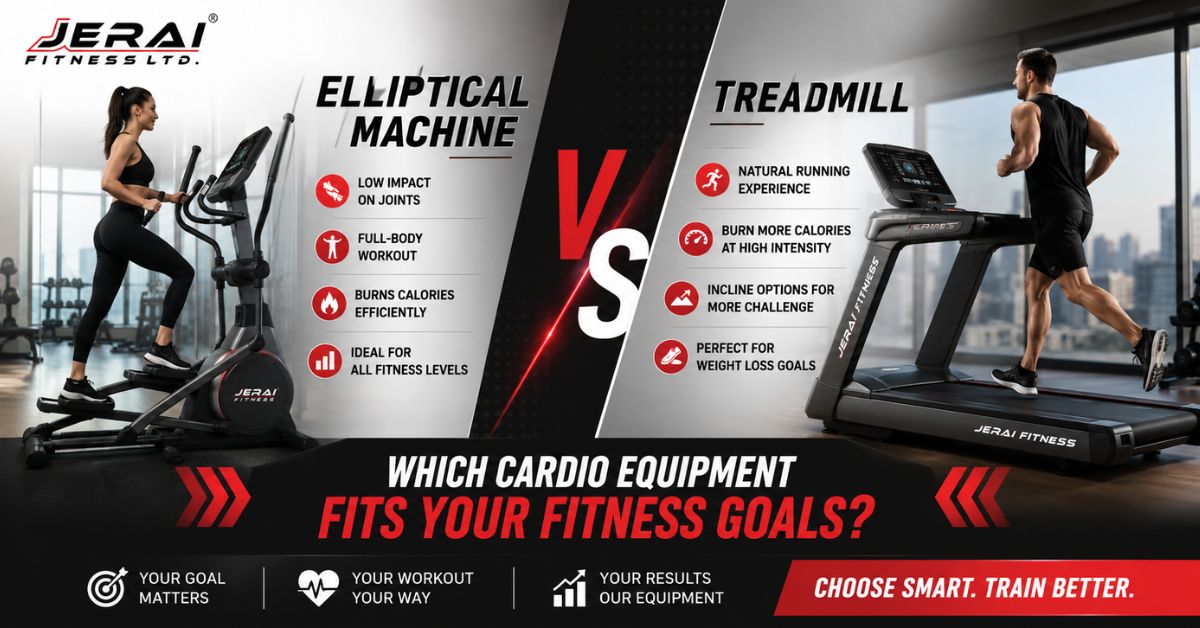
You walk into a gym or browse a fitness equipment site, and two machines dominate the cardio section: the elliptical machine and the treadmill. Both promise better cardiovascular health, calorie burn, and weight management. But they work very differently on your body, and choosing the wrong one for your goals can slow your progress or, worse, lead to injury.
This article breaks down the real differences between these two machines, covers what to pair them with (including the abs machine and shoulder press machine), and helps you decide which setup makes sense for your home gym or training routine.
What Is an Elliptical Machine and How Does It Work?
An elliptical machine moves your legs in a smooth, oval-shaped path. Your feet stay on the pedals throughout, which means there is no repeated footstrike impact on your joints. Most ellipticals also include moving arm handles, which engage your upper body as you push and pull through each stride.
Here is why this matters for joint health. The gliding motion of an elliptical trainer produces substantially lower stress on the knees, hips, and ankles compared to running. That makes it a preferred choice for people with arthritis or joint pain or those recovering from a lower-body injury.
The elliptical activates more quadriceps and produces better quadriceps-to-hamstrings coordination than running on a treadmill. When you use the arm handles, you also recruit the chest, shoulders, and upper back in the same session. That is a meaningful advantage if your goal is full-body conditioning in a single cardio session.
How a Treadmill Works and What Sets It Apart
A treadmill moves a motorized belt at a speed you set. Your job is to keep pace with it. You can walk, jog, or sprint, and you can add an incline to simulate hill training.
Because running is a weight-bearing activity, a treadmill places more physical demand on your body. Each foot strike sends impact forces up through your ankles, knees, hips, and lower back. That impact is not entirely a bad thing. Weight-bearing exercise helps build bone density, which matters for long-term skeletal health.
Treadmills primarily target your calves and glutes more aggressively than ellipticals. They also give you more control over pace, which is useful if you are training for an outdoor race or working on running speed and endurance.
Calorie Burn: What the Numbers Actually Show
This is where most people get the comparison wrong. They assume one machine is dramatically better than the other. Here is what the data shows.
According to Harvard Health data, a person weighing around 70 kg burns approximately 372 calories running on a treadmill for 30 minutes, versus about 324 calories on an elliptical. That is a difference of roughly 48 calories per session.
Research published in the Journal of Strength and Conditioning Research found that at a self-selected exercise intensity, there was no meaningful difference in calorie burn between the two machines. In other words, when the effort level stays constant, the machines are comparable.
A study by the Medical College of Wisconsin found that jogging on a treadmill burns 705 to 866 calories per hour, depending on the individual, speed, and incline. Elliptical workouts at comparable intensity can approach 773 calories per hour.
Here is the practical takeaway. The machine you use consistently and push yourself hardest on will burn more calories over the long term. A 48-calorie difference per session means nothing if joint pain keeps you off the treadmill three days a week.
Joint Impact: The Deciding Factor for Many Buyers
For people with existing knee pain, hip problems, or a history of lower-body injuries, joint impact is not a minor detail. It is the decision.
The elliptical machine eliminates foot-strike impact. Your feet never leave the pedals, which removes the ground reaction forces that accumulate during running. This makes the elliptical a practical option for people who want to train at moderate-to-high intensity without aggravating joints.
Treadmills, on the other hand, produce higher impact with every step. At running speeds, this impact can stress joints over time. That does not make treadmills dangerous, but it does mean they require a gradual build-up in training load, proper footwear, and good running form to stay safe.
Choose the elliptical if: You have joint issues, are returning from injury, or want sustainable long-duration cardio without recovery strain.
Choose the treadmill if: You are healthy with no joint concerns, are training for outdoor running, or prefer the feel of walking and running at controlled speeds.
Muscle Engagement: Upper Body, Lower Body, and Core
Cardio machines are not just for your heart and lungs. Let's break down how each machine actually works.
Elliptical Machine Muscle Activation
-
Quadriceps and hamstrings: The pedaling motion targets both the front and back of the thighs.
-
Glutes: Engaged throughout the stride, especially when you increase resistance.
-
Calves: Activated with each push-through phase.
-
Chest, shoulders, and upper back: Recruited when you use the moving arm handles.
-
Core: Provides stabilization throughout the movement, particularly when you release the handles and rely on balance.
Treadmill Muscle Activation
-
Calves: Treadmills target the calf muscles more effectively than ellipticals.
-
Glutes: Heavily engaged at incline settings.
-
Quadriceps and hamstrings: Both work in the running motion, though with less balanced coordination than the elliptical.
-
Core: Engages for postural support during jogging and running.
If upper-body muscle work matters to you during cardio, the elliptical wins. If maximum calf and glute engagement is the priority, the treadmill at an incline is a strong option.
Where the Abs Machine and Shoulder Press Machine Fit In
Cardio equipment trains your heart and helps with calorie burn. But a complete home gym setup needs more than that. Here is where strength training machines come in.
The Abs Machine
An AB machine, also called an abdominal crunch machine, targets the rectus abdominis (the six-pack muscle), the internal obliques, and the external obliques through a controlled, resistance-based crunch movement.
Research from the Journal of Electromyography and Kinesiology confirms that crunches primarily activate the rectus abdominis. The abs machine adds progressive overload to this movement, something floor crunches cannot easily do. The guided path also reduces strain on the neck and shoulders that often occurs with improper floor crunch form.
For a home gym setup, placing the abs machine after your cardio session makes sense. Your core is already warm, and you can focus on isolated abdominal work without fatigue from earlier training affecting your form.
The abs machine works well for:
-
Beginners are building a mind-muscle connection with their core.
-
People with neck sensitivity who find floor crunches uncomfortable.
-
Anyone looking to add progressive resistance to abdominal training.
The Shoulder Press Machine
The shoulder press machine targets the deltoids, particularly the anterior (front) and medial (side) heads. It also recruits the triceps, upper trapezius, and core stabilizers during the pressing movement.
What makes a shoulder press machine useful in a home gym is the fixed movement path. For beginners, this removes the balanced load of dumbbell presses and lets you focus purely on shoulder activation. For experienced lifters, it allows safe training to near-failure without needing a spotter.
Research confirms that shoulder press variations produce meaningful activation across all three deltoid heads, making the movement valuable not just for pressing strength but for fuller shoulder development.
The shoulder press machine fits well in an upper-body day alongside pulling movements like cable rows or lat pulldowns. Pair it with the abs machine for a time-efficient upper-body and core session.
How these three machines connect: A common and effective weekly layout for a home gym could look like this: elliptical or treadmill for cardiovascular work three to four times a week, with two to three upper-body strength sessions using the shoulder press machine and abs machine.
Space and Budget Considerations for Indian Buyers
Cardio machines take more floor space than strength equipment. Here is a rough comparison for planning purposes:
|
Machine |
Approximate Floor Space |
Price Range (INR) |
|
Elliptical machine |
5 x 2.5 feet |
₹25,000 – ₹120,000 |
|
Treadmill |
6 x 2.5 feet |
₹20,000 – ₹150,000 |
|
Abs machine |
2 x 3 feet |
₹8,000 – ₹30,000 |
|
Shoulder press machine |
3 x 4 feet |
₹15,000 – ₹60,000 |
If floor space is limited, the elliptical often fits more compactly than a full-length treadmill. Some elliptical models also fold for storage.
Budget-wise, an entry-level treadmill's price can be lower than an elliptical of similar build quality, but the maintenance cost on treadmills (motor and belt replacement) tends to be higher over time.
How to Pick the Right Machine for Your Goals
Here is a simple decision framework based on your fitness priorities:
Pick the elliptical machine if you:
-
Have knee, hip, or ankle pain.
-
Want full-body cardio without multiple machines.
-
Plan longer, steady-state cardio sessions (30 to 60 minutes).
-
Are returning from a lower-body injury.
-
Prefer low-impact training as a long-term habit.
Pick the treadmill if you:
-
Have no joint issues and want higher-intensity cardio.
-
Run outdoors and want to replicate that training indoors.
-
Are focused on building running speed or endurance.
-
Prefer interval training (alternating between walking and sprinting).
-
Want to build bone density through weight-bearing exercise.
Use both if you:
-
Have access to a larger home gym space.
-
Want variety to prevent boredom and overuse injuries.
-
Train six or more days a week and need different intensity options.
Building a Complete Home Gym Around These Machines
A well-planned home gym does not need twenty pieces of equipment. A cardio machine, a strength station, and a few accessories can cover the full spectrum of fitness goals.
Jerai Fitness, an Indian manufacturer with over three decades of experience in producing fitness equipment, offers a home range designed specifically for residential use. Their product line includes strength accessories, attachments, dumbbells, plates, barbells, and a range of other equipment suited for home training environments.
A practical home gym combination for most Indian households might include:
-
One cardio machine (elliptical or treadmill, based on the framework above)
-
A multi-gym station or cable unit for pulling movements
-
A shoulder press machine for targeted upper-body strength
-
An ab machine for core isolation work
-
Free weights (dumbbells, a barbell, and plates) for compound lifts
-
A flat or adjustable bench
This setup covers cardiovascular fitness, upper-body and lower-body strength, and core training in one room.
If you are planning a setup like this, Jerai Fitness stocks a range of home gym equipment, including accessories, attachments, and free weights, with GST-inclusive pricing. Their after-sales network includes 52 field technicians across India, which matters when equipment needs service.
Quick Comparison: Elliptical vs Treadmill at a Glance
|
Feature |
Elliptical Machine |
Treadmill |
|
Joint impact |
Very low |
Moderate to high |
|
Calorie burn (30 min) |
~324 calories |
~372 calories |
|
Muscle groups |
Upper and lower body |
Primarily lower body |
|
Bone density benefit |
Limited |
Yes (weight-bearing) |
|
Suitable for injury recovery |
Yes |
No |
|
Training for runners |
No |
Yes |
|
Space requirement |
Compact |
Slightly larger |
|
Maintenance cost |
Lower |
Higher (motor, belt) |
FAQs About Elliptical Machines, Treadmills, and Home Gym Equipment
Q1: Is an elliptical machine good for weight loss?
Yes. An elliptical machine burns around 324 calories per 30 minutes at moderate intensity for a 70 kg person. At higher resistance, the calorie burn increases further. Consistent training on an elliptical, combined with a calorie-controlled diet, supports weight loss effectively with low joint strain.
Q2: Can I replace a treadmill with an elliptical machine at home?
For most people who are not training specifically for running, yes. The elliptical covers cardiovascular conditioning, lower-body muscle work, and calorie burn with less joint impact. If you run outdoor races or need sport-specific treadmill training, keep both or prioritize the treadmill.
Q3: What does the shoulder press machine work, and can beginners use it?
The shoulder press machine targets the anterior and medial deltoids, the triceps, and the upper trapezius. It is one of the more beginner-friendly overhead pressing options because the fixed movement path removes the balance demands of dumbbell presses. Start with lighter loads and increase gradually as your shoulder strength builds.
Q4: Is the abs machine worth buying for a home gym?
The abs machine is worth buying if you want to add progressive resistance to your core training. Unlike floor crunches, the machine lets you increase the weight over time. It also reduces neck and shoulder strain common with improper crunch form. Use it alongside planks and other core movements for a rounded routine.
Q5: How do I decide between an elliptical and a treadmill for a small home gym in India?
Start with your joint health and fitness goals. If you have no joint concerns and want to train for running or higher-calorie-burning sessions, a treadmill fits. If you want a machine that covers upper and lower body cardio with minimal joint stress, the elliptical is the more practical option for most home gym setups in smaller spaces.