

Essential Accessories for Strength Training at Home: A No-Fluff Guide
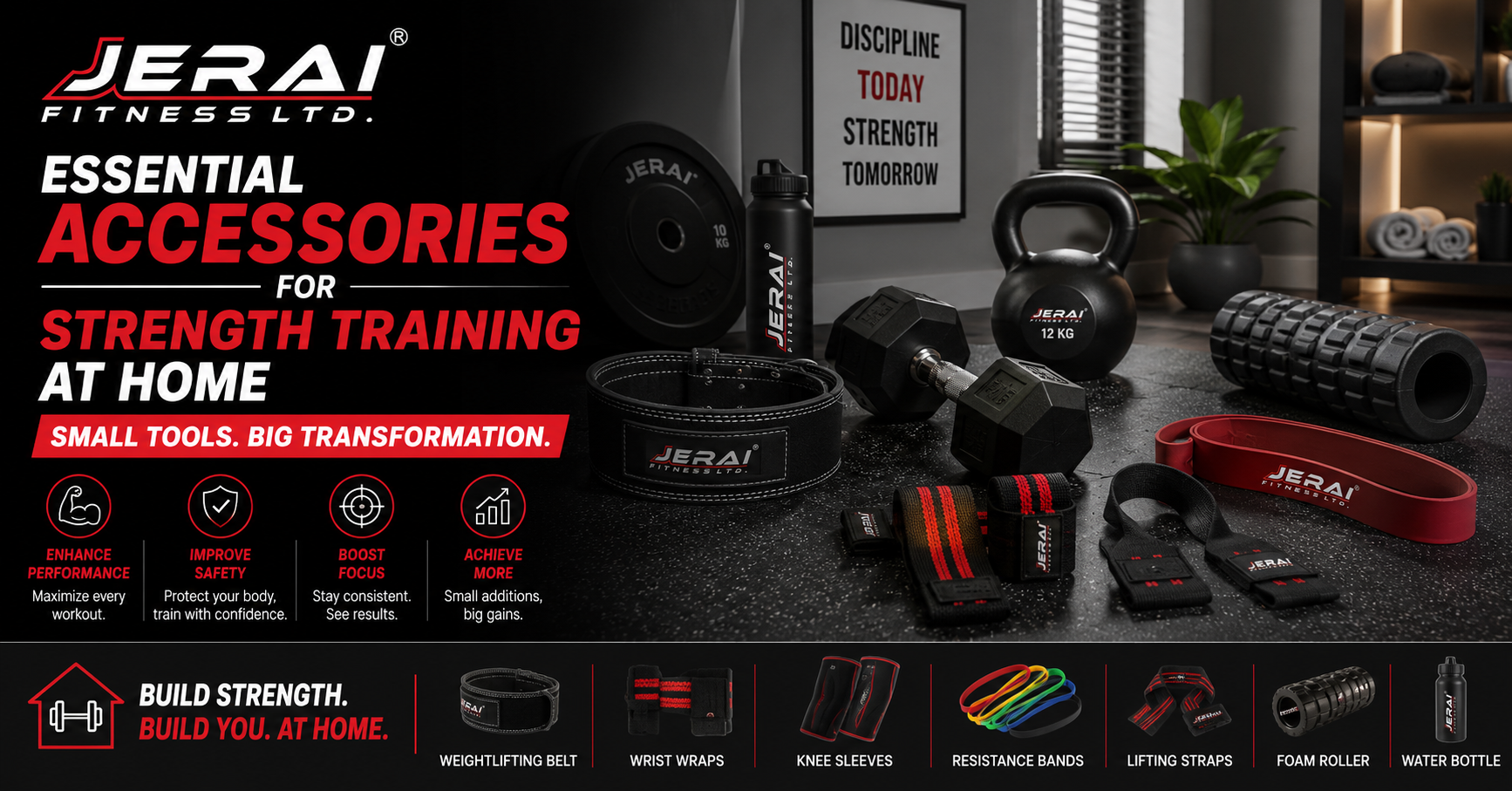
You have the space, you have the motivation, and you are ready to build a home gym. But without the right accessories, even the most dedicated training sessions fall flat. The good news? You do not need to spend a fortune or fill an entire room. A handful of well-chosen accessories for strength training can take your home workouts from average to genuinely productive.
Let us break it down, one accessory at a time.
Why Home Strength Training Accessories Actually Matter
Before we get into the list, here is why this matters.
Strength training at home carries real, science-backed benefits. When done properly, resistance training builds muscle, tendon, and ligament strength, improves joint function, reduces the potential for injury, increases bone density, boosts metabolism, and improves cardiac function. But those benefits depend heavily on having the right tools for the job.
A bare-bones setup leaves gaps. You end up overworking certain muscles, skipping others entirely, and running out of room to progress. The right accessories for strength training fill those gaps without turning your living room into a commercial gym.
Here is what you actually need.
1. Adjustable Dumbbells or a Dumbbell Set
This is where most home gyms should start.
Dumbbells are the most versatile piece of strength training equipment you can own. You can train your chest, back, shoulders, arms, legs, and core with a single set. For safety, look for dumbbells with non-slip handles, and consider having a range of weights so you can gradually increase resistance as you grow stronger.
If space is tight, adjustable dumbbells are a smart pick. They let you go from a light warm-up weight to a heavy working set without stacking up multiple pairs.
At Jerai Fitness, you will find dumbbells, plates, and barbells designed for home use, built to handle consistent, heavy use over time.
What to train with dumbbells:
-
Dumbbell rows for back thickness
-
Goblet squats for lower body strength
-
Shoulder press for overhead pushing
-
Bicep curls and tricep extensions for arm development
2. Resistance Bands
Do not underestimate these. They look simple, but they punch above their weight.
Resistance bands are also commonly used in physical therapy and low-impact training, making them a popular alternative or addition to weight training for many individuals. They come in different resistance levels, so beginners and experienced lifters alike can use them.
Here is something that often surprises people: bands and weights work better together. After using resistance bands, "when I go back to those big foundational moves like the bench press or the squat or the deadlift, I am stronger because I have those accessory muscles now engaging more."
Use bands for warm-up activation, accessory work, and even added resistance on compound lifts. They take up almost no space, cost very little, and last for years when stored properly.
Where bands shine:
-
Glute activation before squats or deadlifts
-
Face pulls and external rotations for shoulder health
-
Banded push-ups to add progressive overload at home
-
Mobility and flexibility work at the end of a session
3. Kettlebells
If you want one piece of equipment that builds strength and conditions your cardiovascular system at the same time, the kettlebell is it.
Kettlebells provide unique resistance training that improves strength, cardiovascular health, and flexibility. Their off-centred weight engages the core, building functional fitness through exercises like swings and goblet squats.
The swing alone is one of the most effective total-body movements you can perform. It trains the posterior chain (glutes, hamstrings, lower back), builds grip strength, and gets your heart rate up fast.
Jerai Fitness carries leather kettlebell sets that are a practical option for home use, covering a range of weights for different exercises and progression levels.
Exercises to start with:
-
Kettlebell swings (posterior chain and cardio)
-
Turkish get-ups (full body stability)
-
Single-arm rows (back and core)
-
Goblet squats (quads, glutes, and upper back)
Start with one or two kettlebells at a weight that challenges you on the fifteenth repetition but does not break your form on the fifth.
4. A Gym Belt
This one surprises people. Many think a lifting belt is only for competitive powerlifters, but it has a practical role in any home gym.
Here is the science behind it. Lifting belts work by increasing the stiffness of the trunk by increasing intra-abdominal and intra-muscular pressures, which allows for more efficient muscular force transfer throughout the body. Research comparing lifts with and without a belt found that subjects had an average intra-abdominal pressure of 156 mmHg without wearing a belt and 175 mmHg with a belt.
The purpose of a weightlifting belt is twofold: it reduces stress on the lower back muscles by allowing the lifter to safely increase intra-abdominal pressure, and it increases the lifter's proprioception, which may lead to a decrease in lumbar hyperextension and other forms of spinal deformation.
That said, a belt is not a substitute for good form. Wear it on your heaviest compound sets, such as squats, deadlifts, and Romanian deadlifts, rather than on every exercise throughout your session.
Jerai Fitness stocks a gym belt designed for home training use, which gives you that trunk support without the bulk of a competition-grade powerlifting belt.
When to use a lifting belt:
-
Deadlifts at 80% or more of your working maximum
-
Barbell squats during heavy sets
-
Overhead press when going heavier
5. A Stability Ball (Anti-Burst)
The stability ball might look like a yoga accessory, but it earns its place in a strength training setup.
Incorporating a stability ball is beneficial for improving flexibility and core strength. You can use it as a bench substitute for dumbbell presses, as a surface for core exercises, or as a prop to increase the difficulty of bodyweight movements like push-ups and planks.
Look for anti-burst versions rated for body weight plus loaded resistance. Jerai Fitness offers anti-burst balls in 55 cm and 95 cm sizes, both built to handle regular training loads.
How to use it for strength training:
-
Stability ball dumbbell press (replaces a flat bench)
-
Ball plank hold (engages deep core muscles)
-
Wall squats with the ball (knee-friendly squat variation)
-
Hamstring curls (lying with heels on the ball)
6. A Battle Rope
Battle ropes sit at the crossover between strength training and conditioning. They train grip, shoulders, arms, and core while keeping your heart rate elevated.
A 12-metre, 38 mm battle rope gives you enough length and resistance for a solid workout in a mid-sized room. Anchor it around a door frame or a dip stand, and you have a tool that adds real variety to your weekly routine.
Jerai Fitness carries a battle rope in this specification, making it a straightforward addition to a home gym already stocked with free weights.
Movements to try:
-
Alternating waves (shoulders and core endurance)
-
Slam variations (full-body power)
-
Side-to-side waves (lateral core stability)
-
Rope circles (shoulder joint health)
7. A Dip Stand
Bodyweight strength is often underrated. A dip stand lets you train chest, shoulders, and triceps with just your body weight, and it takes up less room than a full cable machine.
Dips are a compound pressing movement that loads the triceps, anterior deltoids, and pectorals simultaneously. Add a weight belt over time to progress the movement as you get stronger.
Jerai Fitness offers three dip stand options at different price points, making it easy to pick one based on your budget and the space available in your home.
8. Medicine Balls and Wall Balls
Power training, which is training for speed and force combined, does not get enough attention in home gym equipment setups.
Medicine balls and wall balls fill that gap. Throwing a ball against a wall (wall balls), rotating with it (Russian twists), or performing slam variations builds explosive strength that carries over to athletic performance and daily movement.
Medicine balls are smaller accessories that sit alongside kettlebells and jump ropes as versatile additions to any gym setup. Jerai Fitness carries both medicine ball sets and wall ball sets across different weights so you can start light and progress as your capacity grows.
Building Your Home Gym Accessory Kit: A Suggested Order
Not everyone can buy everything at once. Here is a sensible order to build your kit over time:
Start here (Phase 1):
-
Resistance bands
-
A pair of dumbbells or a dumbbell set
-
Stability ball
Add next (Phase 2):
-
Kettlebell (one to two weights)
-
Gym belt
-
Dip stand
Later additions (Phase 3):
-
Medicine ball or wall ball
-
Battle rope
This order gives you a training-ready setup from day one, and the later additions add variety and progressive challenge over the months ahead.
What to Look for When Buying Strength Training Accessories
Before you purchase, keep these points in mind:
-
Load rating: Make sure any product lists a maximum weight or load it can handle. Never buy blindly on looks alone.
-
Material quality: For items like belts, kettlebells, and dip stands, material durability directly affects safety. Steel, leather, and reinforced rubber all outlast cheaper alternatives.
-
Size for your space: Measure your available floor space before ordering anything larger than a dumbbell set.
-
Manufacturer credibility: Buy from a manufacturer with a track record. Jerai Fitness, for example, has over three decades of manufacturing experience and produces equipment that meets international quality standards.
FAQs
Q1. What are the most space-saving accessories for strength training at home?
Resistance bands, adjustable dumbbells, and kettlebells take up the least space while covering the widest range of exercises. You can store all three in a small corner or a single shelf, making them ideal for apartments or small rooms.
Q2. Do I need a gym belt for home strength training, or is it only for heavy lifters?
A gym belt is useful for anyone performing loaded compound movements like squats, deadlifts, or Romanian deadlifts. It increases intra-abdominal pressure during heavy sets, which helps stabilise the spine. You do not need one for light or accessory work.
Q3. Can I build real muscle with just dumbbells and resistance bands at home?
Yes, absolutely. Dumbbells allow progressive overload, and resistance bands activate smaller stabiliser muscles that free weights sometimes miss. Together, they cover both strength and muscle-building effectively, without needing a full commercial gym setup.
Q4. How heavy should my starting kettlebell be?
Most men starting do well with a 12 kg or 16 kg kettlebell. Most women typically begin with an 8 kg or 12 kg one. Choose a weight that feels challenging by the fifteenth repetition of a swing, but one that you can still control through a full range of motion.
Q5. Are anti-burst stability balls safe for heavy dumbbell presses?
Anti-burst stability balls are designed to deflate slowly rather than pop suddenly, which makes them far safer than standard balls for loaded exercises. Always check the manufacturer's stated weight capacity before using it for weighted pressing or loaded movements.