

Fitness Equipment for Weight Loss at Home: What Actually Works
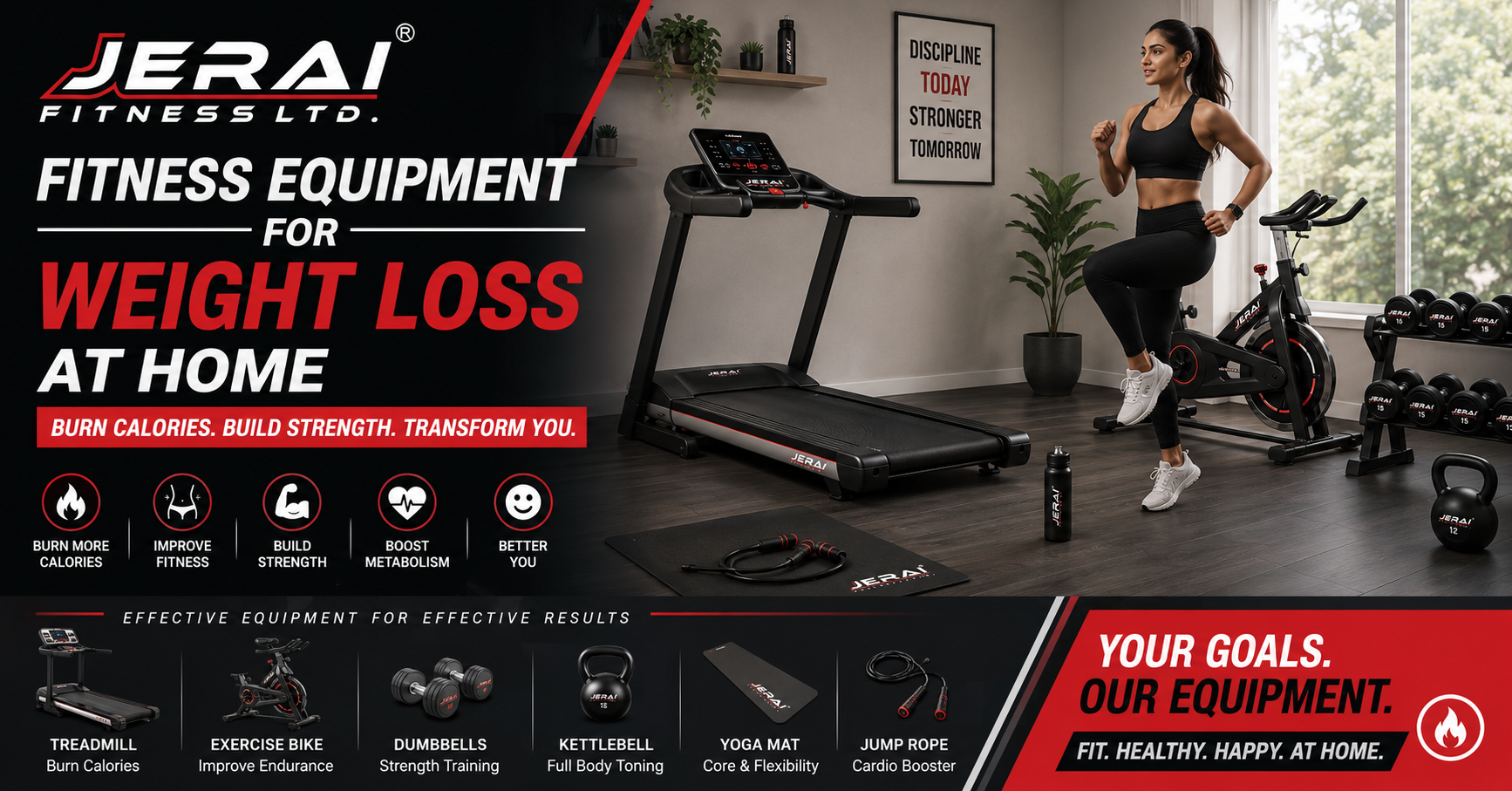
Weight loss with home gym equipment sounds simple on paper. Move more, eat less, repeat. But anyone who has tried doing endless floor exercises in a cramped room knows the reality: without the right equipment, motivation drops quickly and progress stalls.
The good news is that you do not need a full commercial gym to lose weight effectively. You need a smart selection of fitness equipment for weight loss, a plan that combines cardio with resistance training, and enough space to move freely. This guide covers exactly what to buy, why it works, and how to build a setup that fits your home, your goals, and your budget.
Why Cardio Alone Is Not Enough for Weight Loss
Here is something worth understanding before you spend a single rupee on equipment.
Most people associate weight loss with Olympic barbell cardio machines, treadmills, cycles, and steppers. Cardio does burn calories during the session. But resistance training, meaning lifting weights or working against load, does something cardio alone cannot: it builds muscle tissue, and muscle tissue burns more calories at rest than fat tissue does.
A 2012 study published in the Journal of Applied Physiology found that a combination of aerobic and resistance training produced greater reductions in body fat percentage than either mode alone. The American College of Sports Medicine echoes this in its position statement, recommending both aerobic exercise and progressive resistance training for adults seeking fat loss.
What this means for your home gym: buy cardio equipment and resistance training tools. Not one or the other.
The Right Fitness Equipment for Weight Loss at Home: A Category-by-Category Guide
Let's break it down by what each type of equipment does for fat loss specifically.
1. Treadmill: The Workhorse of Home Cardio
A motorised treadmill remains one of the most researched and widely used pieces of cardio equipment for weight loss. You can walk, jog, or run. You can increase the incline to push the heart rate up without increasing pace. And you can train regardless of the weather, which matters a great deal if you live in a city with extreme summers, monsoon flooding, or high pollution.
What to look for in a treadmill for weight loss:
-
Continuous horsepower (CHP) rating of 2.0 or above for regular walking and jogging
-
Speed range of at least 0.5 to 14 km/h
-
Incline range of 0 to 12 percent, as incline walking burns significantly more calories than flat walking at the same pace
-
A running belt at least 50 cm wide and 140 cm long for a comfortable stride
Incline walking deserves a special mention here. Research published in the Journal of Sports Sciences shows that walking on a 5 to 10 per cent incline increases caloric expenditure by 30 to 40 per cent compared to flat walking at the same speed. For people who cannot run due to joint concerns, this makes the incline treadmill a practical fat-burning tool.
The Treadmill F24 from Jerai Fitness is built for home use, with a motorised incline function, variable speed control, and a frame designed for daily residential use without the space demands of commercial treadmills.
2. Spinning Bike: High-Calorie Burn, Low Joint Impact
A spinning bike is lower impact than a treadmill and delivers serious cardiovascular work. The pedalling motion does not load the knees and hips the way running does, making it a strong option for people who carry extra weight, have existing joint concerns, or are returning to exercise after a break.
High-intensity interval training (HIIT) on a spinning bike is one of the most time-efficient calorie-burning methods available. A 2019 review in the British Journal of Sports Medicine found that HIIT training produced comparable or greater improvements in body composition than steady-state cardio in less training time (Source: Sultana RN et al., "Muscular Effects of HIIT versus MICT", British Journal of Sports Medicine, 2019, https://bjsm.bmj.com).
Twenty minutes of hard intervals on a spinning bike can achieve what 45 minutes of moderate jogging does, which is useful if time is your most scarce resource.
What to look for in a spinning bike for home use:
-
Flywheel weight of 18 kg or heavier for smooth, road-like resistance
-
Adjustable seat height and handlebar position to fit different body types
-
Resistance adjustment that allows both low-intensity and high-intensity work
-
A stable base that does not wobble during heavy pedalling
The Pro Spinning Bike from Jerai Fitness carries a heavy flywheel, magnetic resistance, and seat and handlebar adjustability, making it usable for both steady-state cardio sessions and interval training.
3. Dumbbells: The Resistance Training Foundation for Fat Loss
Dumbbells are the single most versatile resistance training tool available for a home gym. They train the chest, back, shoulders, arms, legs, and core. They suit beginners working with light loads and experienced lifters working near their maximum capacity.
Here is why resistance training with dumbbells matters for weight loss specifically. Muscle tissue is metabolically active. A pound of muscle burns roughly 6 to 10 calories per day at rest, compared to 2 calories per day for fat tissue. Building and maintaining muscle through dumbbell training raises your resting metabolic rate, meaning you burn more calories even on days you do not train.
Compound dumbbell movements, those that work multiple muscle groups at once, give you the most calorie burn per set. Dumbbell Romanian deadlifts, goblet squats, dumbbell rows, and dumbbell thrusters all fit this category.
Dumbbell buying tips for weight loss goals:
-
Start with two pairs: a lighter set for isolation movements and a heavier set for compound lifts
-
Rubber-coated dumbbells protect floors and reduce noise in apartments
-
Consider adding a third, heavier pair within six to eight weeks as strength improves
Jerai Fitness carries rubber-coated dumbbells and leather kettlebells in sets suited to home training. Kettlebells, in particular, suit high-rep swing-based exercises that combine resistance work and cardiovascular conditioning in one movement.
4. Kettlebells: Conditioning and Strength Together
Kettlebells deserve their own section because of how well they serve weight loss goals specifically. The kettlebell swing, one of the foundational kettlebell movements, trains the hamstrings, glutes, core, and upper back while keeping the heart rate elevated. It is, in effect, resistance training and cardiovascular work happening simultaneously.
A 2010 study from the American Council on Exercise found that a 20-minute kettlebell snatch session burnt an average of 13.6 calories per minute, which is higher than most traditional steady-state cardio at moderate intensity.
The Leather Kettlebell Set from Jerai Fitness gives you a set of kettlebells suitable for swings, goblet squats, cleans, and presses. The leather coating makes them more comfortable in the palm during high-rep sets compared to bare cast iron.
5. Wall Balls and Medicine Balls: Power and Conditioning
Wall ball throws and medicine ball slams are calorie-intensive conditioning exercises that also develop power in the hips, shoulders, and core. They are included in many fat loss and functional fitness programmes because they train the body to generate and absorb force quickly, which raises exercise intensity and calorie burn.
The Wall Ball Set and Medicine Ball Split Leather Set from Jerai Fitness cover these movements for home training. You need a clear wall or ceiling that can absorb impact if you plan to do overhead throws.
6. Plyometric Softbox: Metabolic Conditioning at Home
Plyometric exercises, box jumps, step-ups, and depth jumps are among the most demanding calorie-burning movements available. They recruit fast-twitch muscle fibres, spike the heart rate quickly, and produce a significant post-exercise oxygen consumption effect (EPOC), meaning your body continues burning calories at an elevated rate for hours after the session ends.
The Plyometric Softbox Set from Jerai Fitness uses a foam-core construction with a soft outer cover, reducing the injury risk associated with traditional wooden or steel plyometric boxes while delivering the same training effect. It suits home training because it does not damage floors and is safe to use without a spotter.
7. Multi-Station Machine or Personal Training Station
If your budget and space allow, a multi-station home gym machine or personal training station gives you cable-based exercises that dumbbell and barbell work alone cannot replicate. Cable pull-downs, cable rows, chest flyes, and cable crunches keep constant tension on the muscles throughout the full range of motion, which is both effective for muscle development and adds variety to prevent training staleness.
The Personal Training Station 360 and the Super Personal Training Station from Jerai Fitness are designed for residential spaces and include multiple cable stations, a pull-up bar, and press attachments. These allow circuit training across different exercises with minimal rest, which keeps the heart rate elevated and delivers both resistance and cardiovascular benefits in a single session.
Building a Weight Loss Training Plan Around Your Home Gym Equipment
Having equipment is only part of the picture. Here is how to structure your training week for fat loss using the equipment above.
3-day strength + 2-day cardio split (for beginners):
-
Monday: Dumbbell strength training (full body, 3 sets per exercise, 10 to 12 reps)
-
Tuesday: Treadmill or spinning bike (30 to 40 minutes at moderate intensity)
-
Wednesday: Rest or light stretching
-
Thursday: Dumbbell and kettlebell training (compound movements focus)
-
Friday: Treadmill intervals or spinning bike HIIT (20 to 25 minutes)
-
Saturday and Sunday: Rest or active recovery (walking, stretching)
4-day strength + cardio split (for intermediate trainees):
-
Monday and Thursday: Resistance training using dumbbells, personal training station, or plyometric box
-
Tuesday and Friday: Cardio sessions alternating between treadmill and spinning bike
-
Wednesday, Saturday, Sunday: Rest or mobility work
Progressive overload matters. Increase resistance, reps, or duration incrementally week by week. The body adapts to fixed loads and stops changing. Keep the stimulus moving forward.
How Much Space Do You Need for a Weight Loss Home Gym?
You do not need a dedicated gym room. Here is a space-by-space breakdown:
-
Under 50 sq ft: Dumbbells, kettlebells, a mat, and resistance bands. Add a spinning bike or a compact treadmill when space allows.
-
50 to 100 sq ft: Dumbbells, kettlebells, a treadmill or spinning bike, and a plyometric box.
-
100 to 200 sq ft: Everything above, plus a personal training station or multi-station machine for cable-based resistance work.
-
200+ sq ft: Full setup with treadmill, spinning bike, weight training area, and conditioning tools (wall balls, plyometric box, and medicine balls).
Rubber interlocking floor tiles (minimum 20 mm thick) protect the floor from impact and keep weights from sliding. Lay them across the entire training area.
FAQs: Fitness Equipment for Weight Loss at Home
Q1. Which home gym equipment is most effective for losing belly fat?
No single piece of equipment targets belly fat specifically. Fat loss occurs across the whole body based on a total calorie deficit. A combination of cardio equipment (treadmill or spinning bike) and resistance training tools (dumbbells, kettlebells) burns the most total calories and raises resting metabolic rate, which together produce the fastest body composition changes over time.
Q2. Is a treadmill or a spinning bike better for weight loss at home?
Both work well. A treadmill suits people who enjoy walking or running and want to replicate outdoor movement patterns. A spinning bike is lower impact and suits people with knee or hip concerns. If you can only choose one, pick the one you are more likely to use consistently. Consistency matters more than which machine is technically superior.
Q3. Can I lose weight at home using only dumbbells, without a treadmill or cycle?
Yes, particularly if you use dumbbells for circuit training with minimal rest between sets, which keeps the heart rate elevated. Compound movements like dumbbell thrusters, Romanian deadlifts, and renegade rows burn significant calories. Add kettlebell swings for conditioning work. Without any cardio machine, expect slower cardiovascular improvement but similar fat loss results if your calorie intake supports a deficit.
Q4. How long should I train each day using home gym equipment to lose weight?
The Indian Council of Medical Research recommends at least 150 minutes of moderate-intensity aerobic activity per week for general health, which works out to 30 minutes per day on five days. For active weight loss, adding two to three days of resistance training of 30 to 45 minutes each week produces better results than cardio alone.
Q5. What is the difference between a personal training station and a regular multi-gym machine for home use?
A personal training station offers cable-based resistance through adjustable pulleys, allowing pull-downs, rows, chest flyes, cable crunches, and more. A standard multi-gym machine typically uses fixed weight stacks and guided movement paths. A personal training station gives more freedom of movement and trains stabiliser muscles more actively. Jerai Fitness offers both the Personal Training Station 360 and the Super Personal Training Station for home setups where cable-based training is a priority.